

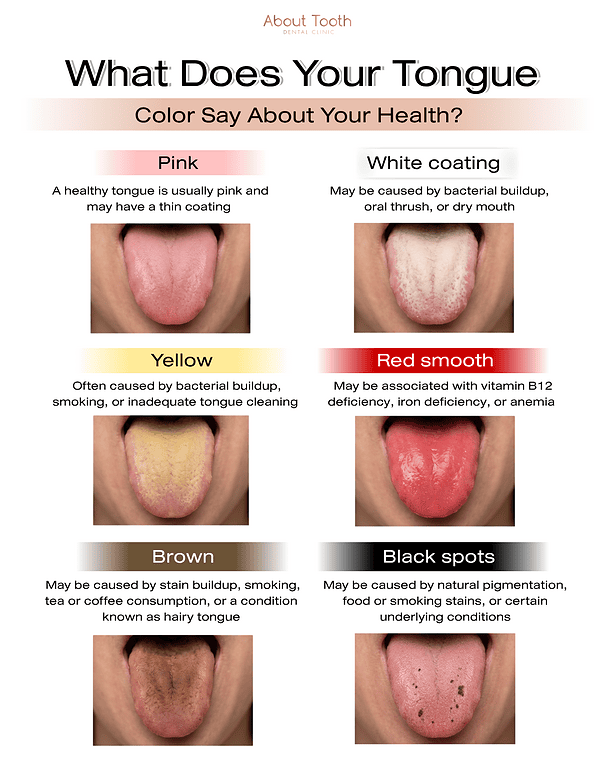
What does your tongue color say about your health?

tongue-color

The color and surface of your tongue can provide early signs of both your oral and overall health. A healthy tongue is usually pink, with a thin white coating and small bumps evenly covering the surface. When the tongue becomes thick white, bright red, black, yellow, purple, or bluish – especially if it is accompanied by pain, burning, sores, or difficulty swallowing – it may be related to infections, vitamin deficiencies, blood vessel problems, or other systemic conditions. In these cases, you should see a dentist or doctor for a proper examination. By regularly checking your tongue along with brushing your teeth, using dental floss, cleaning your tongue, and having routine dental check-ups, you can detect abnormalities earlier and take better care of your health.

What color should a healthy tongue be?

  • A healthy tongue is usually pink, moist, and covered with a thin, light white coating, which is made up of normal bacteria and shed skin cells.
  • The surface of the tongue should have small bumps (papillae) distributed across it, rather than appearing overly smooth or glossy. It should also be free from persistent sores, lumps, or unusual colored spots.

What tongue color can tell you about your health

Tongue color / appearancePossible causes
Pink with a thin coatingThis is generally considered a sign of a healthy tongue.
Thin white coatingIt may be caused by bacterial buildup, food debris, dry mouth, or smoking.
Thick, non‑removable white coatingIt may be associated with oral fungal infection (oral thrush) or other lesions of the oral mucosa.
YellowIt may be caused by bacterial buildup, smoking, tea or coffee stains, or certain gastrointestinal conditions.
Smooth redIt may be associated with vitamin B12 deficiency, iron deficiency, or anemia.

Brown / hairy tongue

It is often caused by buildup from smoking, tea, or coffee, or by elongated papillae that trap pigments on the tongue surface.
Small dark spotsThey may be natural pigmentation, small moles, or stains from food and smoking.
tongue-color-1

Pink

  • This is generally considered a healthy tongue color. A slight thin coating is normal and is usually not related to serious disease, but good oral hygiene is still important.

White coating

  • A thin white coating is often caused by bacteria, food debris, dry mouth, mouth breathing, or smoking, and usually improves with proper toothbrushing, tongue cleaning, and adequate water intake.
  • If the white coating is thick, does not come off, or is accompanied by pain, burning, or difficulty swallowing, it may be related to oral fungal infection (oral thrush), leukoplakia, or other oral mucosal conditions, and you should see a dentist or doctor.

Yellow

  • A yellow tongue is often caused by bacterial buildup, smoking, heavy tea or coffee consumption, or poor oral hygiene, and may sometimes be an early stage before the tongue turns brown or develops a black hairy appearance.
  • In some cases, a yellow tongue may be associated with gastrointestinal problems or liver disease. If you also notice yellow eyes, fatigue, or dark urine, you should consult a doctor.

Red smooth

  • A bright red tongue with a very smooth surface, where the papillae seem to disappear (atrophic glossitis), may be associated with vitamin B12 deficiency, iron deficiency, or certain types of anemia.
  • If the tongue is very red together with high fever or a typical rash, such as a “strawberry tongue,” it may be related to infections like scarlet fever or Kawasaki disease, and urgent medical attention is needed.

Brown

  • A brown tongue is often related to buildup from smoking, drinking tea or coffee, or a “hairy tongue” (black hairy tongue), where the papillae become elongated and trap more pigments. In most cases it is not serious and can improve with quitting smoking, brushing the tongue, and improving oral hygiene.

Black spots

  • Black spots on the tongue may be due to natural pigmentation, such as a melanotic macule, small moles, or stains from food, smoking, or medication.
  • Most of the time they are harmless, but if the dark spots grow, change shape or color, or are associated with sores, pain, or a firm lump, you should see a doctor to rule out precancerous lesions and oral cancer.

What tongue colors or changes should you see a dentist or doctor for?

  • If your tongue color changes noticeably – for example becoming thick white, deep yellow, brown‑black, very bright red, purple, or bluish – and does not improve within 1–2 weeks despite good oral hygiene, you should see a dentist or doctor for an examination.
  • If an abnormal tongue color is accompanied by pain or burning, chronic sores, difficulty swallowing, weight loss, fever, or a firm lump in the mouth, you should see a dentist or doctor promptly.

Simple daily tips for a healthy tongue and mouth

  • Brush your teeth at least twice a day, use dental floss or an interdental brush, and gently clean your tongue with a toothbrush or tongue scraper to reduce buildup and bacteria on its surface.
  • Drink enough water, cut down on smoking, and limit strongly colored drinks such as tea, coffee, and alcoholic beverages. Try to avoid food that is extremely hot or very spicy, as it can irritate the tongue.
  • Visit your dentist regularly for routine oral check‑ups, so they can monitor changes in your tongue, gums, and teeth that may indicate other health problems at an early stage.
 

If you’ve noticed that your tongue or the inside of your mouth looks different lately and you’re not sure whether it’s normal, you’re very welcome to visit any branch of About Tooth Dental Clinic for a check‑up and consultation. Our dental team is ready to carefully examine your oral health, explain the possible causes in simple terms, and recommend the most suitable care for you, so you can get back to your daily life with more comfort and peace of mind.

You can book an appointment with a dentist for consultation and an oral health assessment at About Tooth Dental Clinic. We are open at both our Siam and Punnawithi branches, conveniently located right next to the BTS stations at each location. For more information or to schedule an appointment in advance, please call 087-555-4665 or 080-481-5555, or add us on LINE Official Account at @abouttooth to chat with our team.

References:

  1. Tongue color: What is normal? Medical News Today. Accessed May 28, 2026. from: https://www.medicalnewstoday.com/articles/tongue-color#color-meanings

Book a consultation

Frequently asked questions about tongue health (FAQs)

Q: What tongue color is considered normal?


A: A healthy tongue is usually pink, moist, with a thin white coating and small bumps (papillae) across the surface. It should not have persistent sores, lumps, or unusual colored spots.

Q: Should I be worried if I have a thick white coating on my tongue that does not come off?


A: If the white coating is thick, does not come off, or is accompanied by pain, burning, or difficulty swallowing, it may be related to oral thrush, leukoplakia, or other mucosal diseases. You should see a dentist or doctor for proper evaluation.

Q: Are black spots on the tongue dangerous?

A: Some small black spots may be due to natural pigmentation or stains from food or smoking. However, if a spot becomes larger, changes color or shape, or is associated with sores, pain, or bleeding, you should see a doctor to rule out any serious lesions.