![[:en]การติดรากฟันเทียมแบบทั้งปาก (Full Mouth Dental Implants) เพิ่มคุณภาพชีวิตให้ผู้ที่สูญเสียฟัน](https://www.abouttoothdental.com/wp-content/uploads/2023/04/4-01-768x576.jpg)
All-on-4 is a full-mouth dental implant treatment that uses just four dental implants to support a fixed full-arch prosthesis. It is designed for people who have lost most or all of their teeth in one jaw, providing a stable and functional replacement while using fewer implants than placing an implant for each missing tooth. In many cases, bone grafting may not be necessary.
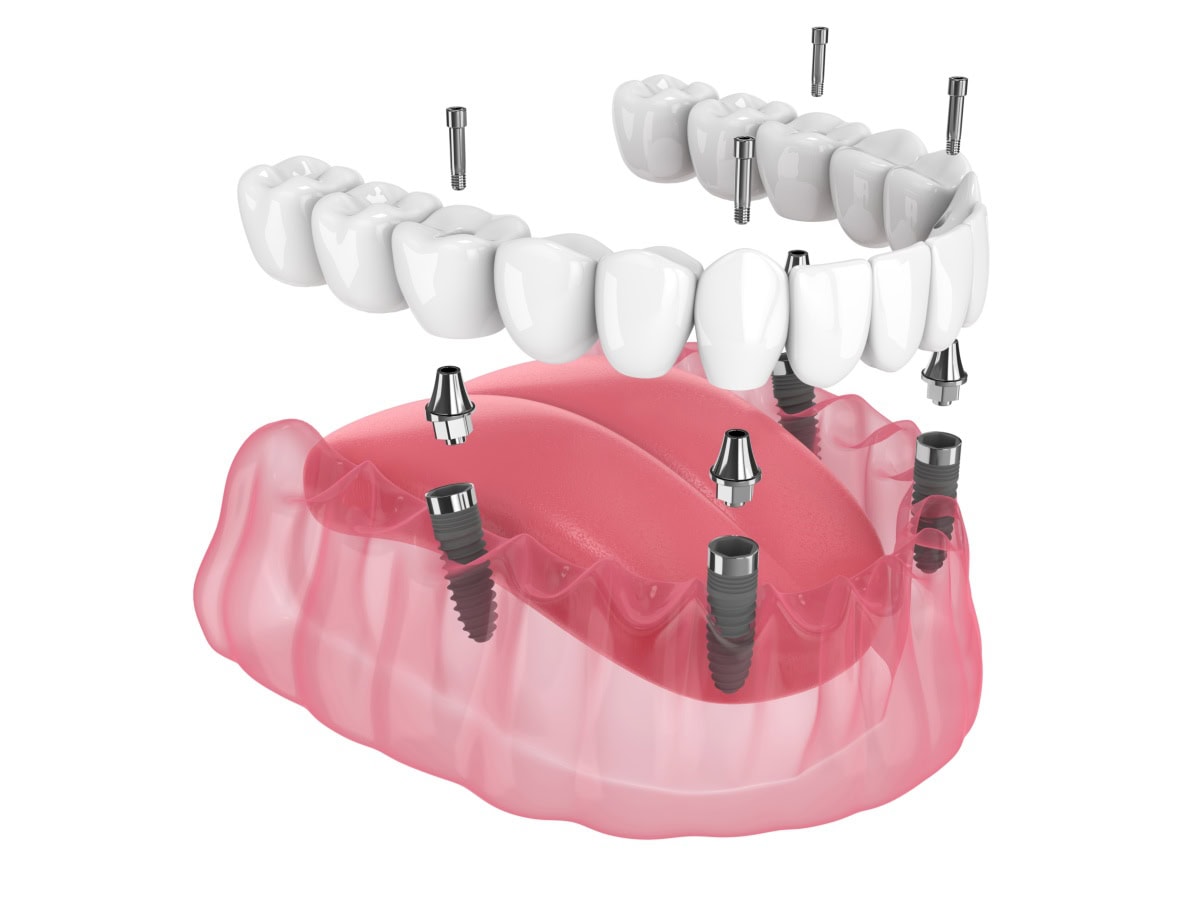
Typically, two implants are placed vertically in the front of the jaw, while the other two are inserted at an angle in the back. This approach takes advantage of the stronger bone in the front of the jaw and helps avoid important anatomical structures such as the maxillary sinuses or the inferior alveolar nerve. Angled implant placement also allows for the use of longer implants, improves support, and enables a fixed bridge to replace an entire arch of teeth.
For suitable candidates, a temporary fixed bridge can often be attached on the same day as implant surgery through a protocol known as immediate loading. This allows patients to regain their smile and chewing function much sooner. Clinical studies have reported high long-term survival rates for both the implants and the prosthesis typically ranging from 94% to 99% over several years—when treatment is carefully planned and appropriate maintenance is followed.
What is All-on-4?
All-on-4 is a dental implant technique that replaces a full arch of teeth using only four dental implants. These implants are strategically placed in the jawbone for maximum stability and support. This method is ideal for patients who have lost most or all of their teeth due to various reasons.
How does All-on-4 work?
The All-on-4 procedure involves surgically placing four dental implants into the jawbone. These implants are angled strategically to provide optimal support for a full arch of teeth. Once the implants are in place, a custom-made dental bridge is attached, resembling natural teeth and offering a permanent solution for tooth loss.
Benefits of All-on-4
All-on-4 offers several advantages. Firstly, it replaces a full arch of teeth with only four implants, surpassing traditional implant methods. Secondly, this technique is less invasive and requires fewer implants and surgeries. Lastly, All-on-4 provides a long-term solution, enhancing patients’ quality of life and self-confidence.
For people who have lost all or most of their teeth, or who have been wearing removable dentures for many years, All-on-4 dental implants can significantly improve quality of life. Compared with conventional removable dentures, All-on-4 provides a more stable and secure solution. Its key advantages include improved stability, better chewing function, and greater comfort and convenience in everyday life.
Key Benefits of All-on-4 Dental Implants
Uses Only Four Dental Implants to Support a Full Arch
- All-on-4 uses just four dental implants to support a full arch of fixed replacement teeth. Compared with replacing each missing tooth individually which may require six to eight implants or more per jaw this approach reduces the number of implants needed.
- Using fewer implants can also simplify the surgical procedure and may shorten the overall treatment time compared with placing multiple individual dental implants throughout the entire arch.
Fixed Teeth That Stay Secure
- The fixed bridge is securely attached to the dental implants, allowing patients to chew with greater confidence. Multiple clinical studies have shown that chewing performance and bite efficiency improve significantly with implant-supported full-arch restorations compared with conventional removable dentures.
- Because the prosthesis remains firmly in place, there is no need to worry about the teeth slipping or becoming loose while speaking, laughing, or eating, helping patients feel more confident in their daily lives.
Helps Reduce Jawbone Loss
- Dental implants transfer chewing forces directly to the jawbone, helping stimulate the bone in a way that is similar to natural tooth roots. Compared with removable dentures, which rest on the gums, implant-supported restorations may help reduce the rate of jawbone resorption over time.
- By helping preserve the jawbone, All-on-4 treatment may also support facial structure and reduce the appearance of facial collapse associated with long-term tooth loss, contributing to a more youthful facial profile.
Temporary Teeth Can Often Be Placed Shortly After Surgery
- The All-on-4 concept was developed to support immediate loading, allowing a temporary fixed bridge to be placed on the same day as implant surgery or shortly afterward for suitable candidates. Eligibility depends on factors such as bone quality and achieving sufficient primary implant stability at the time of implant placement.
- This approach enables many patients to regain their smile and return to their daily routines sooner, even while the dental implants continue to heal and integrate with the jawbone through the natural process of osseointegration.
Who Is a Good Candidate for All-on-4 Dental Implants?
Overall, All-on-4 is best suited for patients who want a fixed full-arch solution and are experiencing multiple dental problems, including extensive tooth loss, difficulty chewing, and reduced confidence in their smile.
Patients Who Are Often Good Candidates for All-on-4
- People who have lost multiple teeth or most of their teeth in the upper jaw, lower jaw, or both.
- Long-term removable denture wearers who experience loose dentures, difficulty chewing, or frequent sore spots caused by denture pressure.
- Patients with advanced periodontal (gum) disease resulting in multiple loose teeth, where a dentist determines that the remaining teeth cannot be predictably preserved over the long term.
- People seeking a long-term fixed solution that closely resembles natural teeth in both function and appearance, and who are willing to invest in improving their long-term oral health and quality of life.
Is All-on-4 right for you?
All-on-4 is one of dental implant techniques, particularly suitable for individuals with extensive tooth loss. It provides a permanent solution that improves both quality of life and self-esteem. If you are interested in learning more about the All-on-4 method, please consult with our dentist to determine if this option is right for you. About Tooth Dental Clinic has multiple branches in the Sukhumvit area offering Dental implants and All-on-4 Method. Our team will guide you through the process and create a tailored treatment plan to suit your needs.
What Should Be Evaluated Before Choosing All-on-4?
Oral Examination and X-rays / CT Scan
- A comprehensive oral examination, together with dental X-rays and a 3D CT scan, is essential to evaluate the quantity and quality of the jawbone, determine the optimal implant positions, and identify important anatomical structures such as the maxillary sinuses and the inferior alveolar nerve.
Medical Conditions and Current Medications
- Certain medical conditions and medications may affect healing and the long-term success of dental implants. For example, poorly controlled diabetes, heavy smoking, and the use of certain medications may increase the risk of complications. These factors should be carefully assessed by the dental team and, when appropriate, in consultation with the patient’s physician.
Commitment to Long-Term Oral Care
- Although All-on-4 provides a fixed full-arch restoration, it still requires good oral hygiene and regular professional maintenance. Keeping the areas around the implants and the fixed bridge clean is essential to help reduce the risk of gum inflammation and peri-implant disease, supporting the long-term success of the treatment.
At About Tooth, our dental team performs a comprehensive assessment using digital X-rays or 3D CT imaging, evaluates your overall oral health and medical history, and develops a personalized treatment plan tailored to your individual needs.
Comparing Full-Mouth Tooth Replacement Options
Comparison | All-on-4 (Full-Mouth Dental Implants) | Full Removable Dentures | Individual / Multiple Dental Implants |
Stability | Fixed securely to dental implants, providing excellent stability for chewing | May become loose over time, especially as the jawbone resorbs, limiting chewing efficiency | Highly stable, with each implant supporting an individual crown or a short-span bridge |
Number of Implants | Typically 4 implants per arch (5–6 implants in some cases) | No dental implants; the denture rests on the gums and jawbone | Usually 6–8 implants or more for full-arch rehabilitation |
Effect on Jawbone | Helps stimulate the jawbone through chewing forces, reducing bone loss | Does not stimulate the jawbone, allowing bone resorption to continue over time | Also helps preserve the jawbone, although additional bone grafting may be required in some cases |
Time to Functional Teeth | Many patients can receive a temporary fixed bridge on the same day or shortly after surgery | Can usually be worn immediately after fabrication | Typically requires several months for the implants to integrate with the bone before the final restorations are placed |
Chewing Performance | Close to natural teeth, allowing patients to enjoy a wider variety of foods | Chewing ability is more limited, particularly with hard or chewy foods | Provides chewing function closest to natural teeth, although treatment generally takes longer |
Jawbone Preservation | Helps reduce jawbone resorption by transferring chewing forces to the bone | Does not help prevent bone loss | Helps preserve the jawbone in the same way as conventional dental implants |
Overall Cost | Higher initial investment than removable dentures, but generally more cost-effective than replacing every missing tooth with individual implants | Lowest initial cost | Highest overall cost for full-mouth rehabilitation due to the greater number of implants and restorations |
The All-on-4 Treatment Process at About Tooth
The treatment plan may vary depending on each patient’s oral condition and jawbone quality. However, the All-on-4 procedure generally follows these key steps, in line with internationally recognized treatment protocols.
1. Consultation and Treatment Planning with X-rays and 3D CT Scan
Your dentist will perform a comprehensive oral examination and take dental X-rays and a 3D CT scan to evaluate the quality and quantity of your jawbone, identify important anatomical structures, and determine the ideal implant positions. Digital impressions or an intraoral scan may also be taken to help plan the final tooth position and design your new smile.
2. Tooth Extraction (If Needed) and Oral Preparation
If any remaining teeth are unlikely to be preserved over the long term, your dentist may recommend extracting them during the same appointment as implant placement. Any existing gum disease or other oral health conditions will also be treated to ensure your mouth is well prepared before surgery.
3. Placement of Four Dental Implants
Four dental implants are placed following the All-on-4 concept, with two implants positioned vertically in the front of the jaw and two implants angled in the back. This approach maximizes the use of available bone while avoiding important anatomical structures.
The procedure is typically performed under local anesthesia. Depending on the complexity of the case and the patient’s needs, conscious sedation or general anesthesia in a hospital setting may also be considered.
4. Temporary Fixed Teeth for Suitable Candidates
If sufficient primary implant stability is achieved and the clinical conditions are appropriate, a temporary fixed bridge may be placed on the same day as surgery or shortly afterward.
This allows many patients to return to their normal daily activities with a fixed set of teeth while following a soft-food diet and other postoperative instructions during the healing period.
5. Healing and Osseointegration
Over the following months, the implants gradually fuse with the jawbone through a natural biological process known as osseointegration.
During this healing phase, regular follow-up visits are scheduled to monitor recovery, evaluate implant stability, and maintain good oral hygiene around the implants.
6. Final Fixed Bridge and Follow-Up Care
Once the implants have fully integrated with the jawbone, digital impressions or an intraoral scan are taken to fabricate a custom-made final fixed bridge designed to provide optimal function, aesthetics, and a comfortable bite.
After the final restoration is placed, regular follow-up appointments are recommended to monitor the implants, make any necessary bite adjustments, and professionally clean around the implants and beneath the fixed bridge to help ensure long-term success.
How Much Do All-on-4 Dental Implants Cost?
The cost of All-on-4 dental implants varies depending on each patient’s oral condition and treatment needs. Factors that may affect the overall cost include:
- Whether treatment is required for the upper arch, lower arch, or both arches
- The brand and type of dental implants and the materials used for the fixed bridge
- Whether additional procedures, such as tooth extractions or other dental treatments, are required
- The complexity of the case, including the amount of remaining jawbone and whether additional surgical procedures are needed
Compared with replacing every missing tooth with an individual dental implant, All-on-4 is often considered a more cost-effective solution for full-mouth rehabilitation. Because it requires fewer implants, and many patients may not need bone grafting, the overall treatment is generally less complex. However, All-on-4 is typically more expensive than removable dentures, as it involves implant surgery and a custom-made fixed prosthesis.
For a more accurate estimate of the cost of All-on-4 dental implants at About Tooth, we recommend sending us photos of your teeth along with your dental X-rays. Our dental team can then provide a preliminary assessment and a personalized treatment estimate based on your individual case.
Aftercare and Follow-Up for All-on-4 Dental Implants
Proper aftercare plays a vital role in the long-term success of All-on-4 dental implants and the fixed bridge. Although clinical studies have reported high long-term success rates, maintaining good oral hygiene and attending regular follow-up appointments are essential for preserving the health of the implants and surrounding tissues.
Aftercare Guidelines for All-on-4 Dental Implants
The First Few Weeks After Surgery
- During the initial healing period, patients are advised to eat soft foods and avoid hard, crunchy, or sticky foods to minimize excessive pressure on the newly placed implants.
- If your dentist prescribes antibiotics or pain medication, be sure to take them exactly as instructed to support healing and reduce the risk of complications.
Daily Oral Hygiene
- Good oral hygiene is essential for maintaining the long-term health of All-on-4 dental implants. Brush both the fixed bridge and the surrounding gums thoroughly using a soft-bristled toothbrush, and use an antimicrobial mouthwash if recommended by your dentist.
- To clean beneath the bridge and around the implants, use implant floss (super floss) or a water flosser. These tools help remove plaque and food debris from hard-to-reach areas, reducing the buildup of plaque and tartar around the implants.
Regular Follow-Up Visits Every 6–12 Months
- Regular check-ups are essential for maintaining the long-term health of All-on-4 dental implants. During these visits, your dentist will examine the gums, jawbone, and dental implants, assess your bite, and check the screws securing the fixed bridge to ensure everything remains stable.
- Professional cleaning around the implants and beneath the fixed bridge, including the removal of plaque and tartar, helps reduce the risk of peri-implant inflammation and supports the long-term success of your implant treatment.
Restore Your Full Smile with All-on-4 at About Tooth If you have lost multiple teeth, have loose teeth caused by advanced gum disease, or no longer feel confident wearing removable dentures, All-on-4 dental implants may be the solution you’re looking for. This treatment can help restore a fixed, full-arch smile, allowing you to enjoy greater comfort when chewing and smile with confidence again. At About Tooth Dental Clinic, our experienced dental team at both our Siam branch (8th Floor, SIAMSCAPE) and Punnawithi branch (2nd Floor, True Digital Park, connected to BTS Punnawithi) is ready to create a personalized treatment plan designed to provide long-lasting function, comfort, and a natural-looking smile.
You can book an appointment with a dentist for consultation and an oral health assessment at About Tooth Dental Clinic. We are open at both our Siam and Punnawithi branches, conveniently located right next to the BTS stations at each location. For more information or to schedule an appointment in advance, please call 087-555-4665 or 080-481-5555, or add us on LINE Official Account at @abouttooth to chat with our team.
References:
- All-on-4. Accessed June 22, 2026. from: https://malocliniceducation.com/all-on-4-2/


Dr. Papatsara Veerapol, D.D.S. is a dentist specializing in orthodontics, dental implants, and prosthodontics (veneers, dentures). She graduated with honors (Second Class) from the Faculty of Dentistry at Chulalongkorn University. She later earned a Master’s degree in Prosthodontics from Srinakharinwirot University. With extensive work experience, she holds an Advanced General Dentistry Certificate and is certified as a Platinum Provider of Invisalign for 2021 and achieved Zenyum Star Tier status in 2023.
Currently, she is the founder of About Tooth Dental Clinic, which was honored with the World Class Award 2021 in the category of The Best of International Healthy Business. She also serves as a member of the Thai Association of Dental Implants (TADI) and the Thai Prosthodontics Association.