
Key Takeaways
Dentures are removable prosthetics that replace missing teeth without surgery, while dental implants are titanium posts surgically placed in the jawbone to anchor permanent replacement teeth. Dental implants preserve jawbone density through osseointegration, whereas traditional dentures can accelerate bone loss over time and may require replacement every five to seven years. Implants cost more upfront but typically deliver stronger long-term value, while dentures are more accessible for patients with budget or health constraints. Candidacy for implants depends on bone density, overall health, and lifestyle factors, so a comprehensive dental evaluation with scans is the essential first step.
Losing a tooth changes more than your appearance. Everyday tasks like chewing a meal, speaking clearly, or smiling in a photo suddenly feel different. For anyone dealing with one or several missing teeth, two options come up in almost every conversation: dentures and dental implants. Both can restore function and confidence, but they work in very different ways and suit very different situations.
Between dentures vs implants, the right decision often comes down to cost, comfort, lifestyle, and long-term health goals. Understanding what each option involves, what it costs, and how it holds up over the years helps you make the best choice.
If you’re weighing these two options, here’s what you need to know before making that call.
What Are Dentures?
Dentures are removable prosthetic devices designed to replace missing teeth and the surrounding tissue. They sit on your gums and are held in place by suction, natural oral anatomy, or a denture adhesive. Modern dentures look far more natural than older versions, though they still come with trade-offs in comfort and function.
There are two main types:
- Full dentures replace an entire arch of teeth (upper, lower, or both)
- Partial dentures fill gaps when some natural teeth remain, clipping onto your existing teeth using a metal or acrylic framework.
Between the two, dentures don’t require surgery, they’re more affordable upfront, and a dentist can fit them relatively quickly. The downsides? They can slip during meals or conversations, reduce your bite force by up to 75% compared to natural teeth, and require adhesives for a secure fit.
Also, dentures can contribute to jawbone loss over time because they rest on the gums without stimulating the underlying bone.
What Are Dental Implants?
A dental implant is a small titanium post surgically placed into the jawbone to serve as an artificial tooth root. Through osseointegration, the post fuses with the bone, creating a permanent foundation for a crown or bridge. Studies show implant success rates ranging from 95% to 98%, with properly maintained implants lasting well beyond 20 years.
Implant solutions come in several forms:
- A single-tooth implant: Replaces one tooth without affecting neighbors.
- Implant bridges: Replaces several teeth using fewer posts.
- Full-arch solutions: These use four to six implants to support a full set of fixed teeth.
Implants offer the most natural feel and preserve bone health. However, they have a higher upfront cost and a surgical procedure, with some cases also requiring bone grafting before placement.
Permanent Dentures vs Implants: Clearing Up the Confusion
Permanent dentures vs implants is really a comparison between two types of implant-supported solutions: removable overdentures and fixed full-arch bridges.
Snap-in overdentures clip onto two to four implant posts in the jawbone. You can remove them for cleaning, but they’re far more stable than traditional dentures. Fixed full-arch bridges, like the All-on-4 or All-on-6, are permanently secured to four or six implants and do not come out.
| Feature | Traditional Dentures | Snap-in Overdentures | All-on-4 Fixed Bridge |
| Stability | Low (adhesive needed) | Moderate to high | Highest (fixed in place) |
| Bone Preservation | None | Partial | Yes (stimulates jawbone) |
| Chewing Power | ~25% of natural teeth | ~60% of natural teeth | ~90% of natural teeth |
| Upfront Cost | Lowest | Moderate | Highest |
| Removable? | Yes | Yes (clips on/off) | No (permanently fixed) |
| Lifespan | 5-7 years | 10-15 years (prosthetic) | 20+ years (implant posts) |
Dentures vs Implants Cost in 2026
The first bill doesn’t tell the full story when it comes to dentures vs implants cost. Dentures need relining every one to two years, and full replacement every five to seven years as the jawbone changes shape. Add in adhesives, cleaning solutions, and repair visits, and the cumulative spend over a decade or two adds up quickly.
While the upfront cost of implants is higher, they often prove more economical over a 20-year window because they don’t require the frequent relining or replacement that dentures do.
- Traditional Dentures: 15,000 – 40,000 THB per arch.
- Single Implant: 25,000 – 45,000 THB (post, abutment, and crown).
- All-on-4 Restorations: 250,000 – 480,000 THB per arch.
Note: Factors like bone grafting, sinus lifts, and premium brand selection (e.g., Straumann) will influence the final quote.
Are Implants Better Than Dentures?
It depends on your priorities. Implants are superior in three key areas:
- Chewing efficiency: Traditional dentures restore roughly 25% of natural bite force. Snap-in overdentures push that closer to 60%. Fixed implant bridges like All-on-4 deliver around 90%, which means you can eat steak, apples, and nuts with confidence.
- Comfort and speech: Slipping dentures can cause sore spots on the gums and affect pronunciation. Implants are anchored in the jaw, so there’s no movement and no adhesive residue to deal with.
- Facial support: When a tooth root is missing, the jawbone beneath it begins to resorb. Over the years, this leads to a sunken facial appearance that ages you prematurely. Implants are the only tooth replacement option that actively stimulate the jawbone and prevent this type of bone loss.
- Oral health: Implants don’t rely on neighboring teeth for support (unlike partial dentures or bridges), which means your remaining natural teeth stay untouched.
Who Is a Good Candidate for Each?
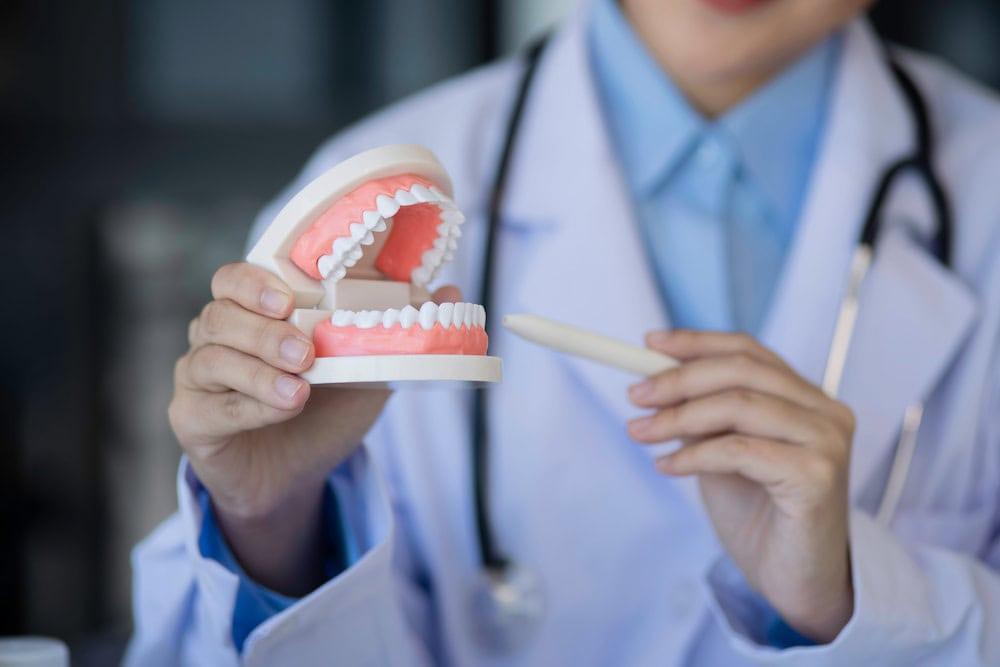
Implant candidacy hinges on a few key factors.
- Implants: These require adequate bone density and good overall health. Conditions like uncontrolled diabetes or heavy smoking may complicate the healing process.
- Dentures: A practical choice for those who want a non-invasive, quick solution or have health concerns that rule out minor surgery.
It’s also important to note that age alone doesn’t determine the right choice. What matters more is your oral health status, how many teeth need replacing, your lifestyle, and how much maintenance you’re prepared to take on over the long haul.
How to Choose: A Simple Step-by-Step
- Get a comprehensive dental evaluation. This includes a full oral exam, digital X-rays or CT scans, and a review of your medical history. Your dentist needs a complete picture before recommending any treatment.
- Compare your options side by side. Once the evaluation is done, your dentist can present which solutions are viable for your specific case, along with realistic outcomes for each.
- Map out the full picture. Factor in treatment phases, healing time, follow-up appointments, and long-term maintenance. Ask about financing options and phased treatment plans if the upfront cost of implants feels steep.
Restore Your Smile with the Right Tooth Replacement
Between dentures and implants, there’s no real wrong option. Implants offer the most natural feel, preserve your jawbone, and deliver strong, long-term value. Dentures remain a practical, non-surgical option for patients with budget or health constraints. Both have their ideal use cases, and what’s important is choosing the one that best fits your individual dental needs.
Cue About Tooth Dental Clinic. We’re a trusted dental clinic in Bangkok with branches near BTS Punnawithi and BTS Siam. Our experienced implant specialists use advanced technology, including 3D imaging and digital treatment planning, to help you confidently make the right choice, all in a friendly atmosphere, with transparent pricing and comprehensive services.
Book a consultation at About Tooth Dental Clinic for a personalized treatment plan and clear all-on-4 dental implants costs. We make restoring your smile convenient at every step.

References:
Optimizing Osseointegration in Dental Implantology: A Cross-Disciplinary Review of Current and Emerging Strategies. Retrieved on 20 April 2026 from https://pmc.ncbi.nlm.nih.gov/articles/PMC10685082/
Observational Study on the Success Rate of Osseointegration: A Prospective Analysis of 15,483 Implants in a Public Health Setting. Retrieved on 20 April 2026 from https://www.mdpi.com/2673-8430/2/4/33
Frequently Asked Questions About Dentures vs Implants
Q: Can I switch from dentures to dental implants later?
A: Yes, many patients start with dentures and later upgrade to implant-supported solutions when they are ready. Your dentist will assess your jawbone density and overall oral health to determine if you are a good candidate for implants. In some cases, bone grafting may be needed if significant bone loss has occurred from long-term denture use.
Q: Who is not a good candidate for dental implants?
A: Patients with uncontrolled diabetes, heavy smokers, individuals undergoing certain cancer treatments, and those with severe bone loss that cannot be corrected with grafting may not be ideal candidates for dental implants. A thorough dental evaluation including scans and medical history review is needed to determine eligibility. In these cases, dentures or implant-supported overdentures may be a more suitable alternative.
Q: What is the difference between permanent dentures and dental implants?
A: Permanent dentures are actually implant-supported prosthetics, not traditional removable dentures. They are secured to dental implants placed in the jawbone, which keeps them stable and prevents slipping. Standard dental implants refer to individual titanium posts topped with a crown to replace single teeth. Both rely on implants for stability, but permanent dentures replace a full arch of teeth on four to six implant posts.

Dr. Nisara Tanarerkchai, D.D.S. is a dentist specializing in dental implants, orthodontics, and veneers. She graduated from the Faculty of Dentistry at Thammasat University. With extensive professional experience, she holds multiple certificates in various dental fields, including Advanced General Dentistry, Dental Implants, Advanced Orthodontics, as well as certificates in the Veneer Bootcamp and the Veneer Masterclass. Additionally, she is certified as a Platinum Provider of Invisalign for 2021 and achieved Zenyum Star Tier status in 2023.
Currently, Dr. Thanaruksachai is the founder of About Tooth Dental Clinic, which received the World Class Award 2021 in the category of The Best of International Healthy Business. She is also serves as a member of the Thai Association of Dental Implants (TADI).